Rethinking Cloud Egress: My Deep Dive into Amazon VPC’s Regional NAT Gateway

👋 Welcome to my Hashnode profile! I'm a passionate technologist with expertise in AWS, DevOps, Kubernetes, Terraform, Datree, and various cloud technologies. Here's a glimpse into what I bring to the table: 🌟 Cloud Aficionado: I thrive in the world of cloud technologies, particularly AWS. From architecting scalable infrastructure to optimizing cost efficiency, I love diving deep into the AWS ecosystem and crafting robust solutions. 🚀 DevOps Champion: As a DevOps enthusiast, I embrace the culture of collaboration and continuous improvement. I specialize in streamlining development workflows, implementing CI/CD pipelines, and automating infrastructure deployment using modern tools like Kubernetes. ⛵ Kubernetes Navigator: Navigating the seas of containerization is my forte. With a solid grasp on Kubernetes, I orchestrate containerized applications, manage deployments, and ensure seamless scalability while maximizing resource utilization. 🏗️ Terraform Magician: Building infrastructure as code is where I excel. With Terraform, I conjure up infrastructure blueprints, define infrastructure-as-code, and provision resources across multiple cloud platforms, ensuring consistent and reproducible deployments. 🌳 Datree Guardian: In my quest for secure and compliant code, I leverage Datree to enforce best practices and prevent misconfigurations. I'm passionate about maintaining code quality, security, and reliability in every project I undertake. 🌐 Cloud Explorer: The ever-evolving cloud landscape fascinates me, and I'm constantly exploring new technologies and trends. From serverless architectures to big data analytics, I'm eager to stay ahead of the curve and help you harness the full potential of the cloud. Whether you need assistance in designing scalable architectures, optimizing your infrastructure, or enhancing your DevOps practices, I'm here to collaborate and share my knowledge. Let's embark on a journey together, where we leverage cutting-edge technologies to build robust and efficient solutions in the cloud! 🚀💻
When you’ve been building in the cloud long enough, certain patterns become second nature—like placing a NAT Gateway inside a public subnet in each Availability Zone so your private workloads can reach the internet. It’s predictable, reliable, and… honestly, a little outdated.
This year, AWS quietly changed the game with a feature that fundamentally simplifies traditional NAT architectures:
the Amazon VPC Regional NAT Gateway (RNAT).
What began as a small curiosity turned into a full-scale experiment. I built test environments, pushed traffic through multiple AZs, deleted subnets I shouldn’t delete, forced expansions, and watched the behavior unfold.
This blog captures everything I learned — the “why,” the “how,” and the “wow” moments that prove RNAT isn’t just new… it’s transformational.
Why Traditional NAT Needed an Upgrade
Traditional NAT Gateways (zonal NATs) have served well for years, but they come with well-known limitations:
❌ Cross-AZ Charges Add Up
A private instance in AZ-B using a NAT Gateway in AZ-A incurs cross-AZ data charges. That adds unnecessary expense.
❌ One NAT per AZ = Higher Cost & Complexity
A three-AZ VPC means:
3 NAT Gateways
3 Elastic IPs
3 public subnets
3 sets of routing rules
❌ NAT Gateway Failure = AZ-Level Outage
If the AZ hosting your NAT gateway has issues, private subnets in that AZ lose internet access unless you deployed redundant NATs.
❌ Public Subnet Required per AZ
You must create public subnets even when you don’t want any public infrastructure.
These pain points set the stage for something better.
Enter the Regional NAT Gateway — A Smarter Way Forward
The Amazon VPC Regional NAT Gateway (RNAT) is fundamentally different.
RNAT is a VPC-wide, region-scoped NAT service that automatically supports all Availability Zones—without needing multiple NAT gateways or public subnets.
Why RNAT Is a Game Changer
1. One NAT for the Whole Region
Instead of one NAT per AZ, RNAT gives you:
1 Regional NAT Gateway → All AZs Covered
No need to repeat NAT infrastructure for each AZ.
2. No Cross-AZ NAT Charges
Traffic no longer jumps AZs for NAT processing.
Everything is handled regionally → zero cross-AZ NAT charges.
3. Automatic Expansion Into New AZs
If traffic appears in a new Availability Zone, RNAT expands automatically.
No Terraform updates.
No additional NAT gateways.
No manual routing changes.
4. No Public Subnet Required
RNAT is not deployed inside a subnet.
You can delete your public subnet, and RNAT continues working.
5. Automatic Port & EIP Scaling
Under heavy traffic, RNAT automatically increases:
Connection capacity
Elastic IP count
Per-AZ presence
No admin intervention needed.
6. High Availability Built-In
RNAT inherently spans multiple AZs.
An AZ outage doesn’t take NAT down.
How I Tested RNAT (And What I Observed)
Here’s what I actually tried while experimenting:
✔ EC2s in multiple AZs all used the same RNAT IP
✔ deleting the public subnet did NOT break NAT
✔ RNAT expanded into unused AZs within ~20–60 mins
✔ Heavy traffic caused RNAT to add more EIPs dynamically
✔ No cross-AZ charges appeared in billing
The experience was shockingly smooth.
Step-by-Step: Creating a Regional NAT Gateway
This section includes visual guides so you can follow along easily.
🔹 Step 1 — Open NAT Gateway Console
Go to:
VPC Console → NAT Gateways → Create NAT Gateway
🔹 Step 2 — Select Availability Mode: REGIONAL
This is the most important option.
Choose:

This tells AWS you want a single NAT Gateway that spans the entire region.
🔹 Step 3 — Choose Your VPC & Elastic IP
You do not select a subnet (because RNAT is not tied to one).
Just pick:
VPC name
Elastic IP (automatic or custom)
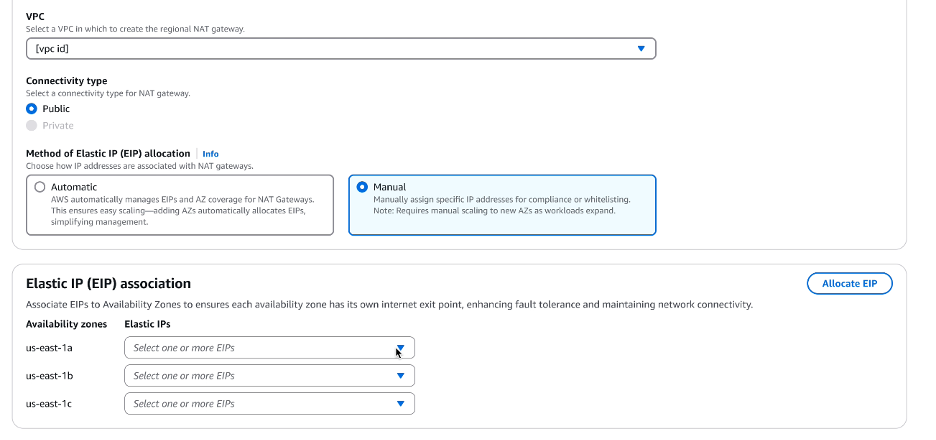
🔹 Step 4 — Create the NAT Gateway
Click Create NAT Gateway.
Within seconds, RNAT is ready.
🔹 Step 5 — Update Private Subnet Route Tables
Route:
0.0.0.0/0 → Regional NAT Gateway
Done. Your workloads now use RNAT for outbound traffic.
How RNAT Solves NAT Cost and Complexity Issues
Let’s compare the two architectures.
🆚 Traditional Zonal NAT vs Regional NAT
Traditional NAT (Before)
AZ-a → NAT A → IGW
AZ-b → NAT B → IGW
AZ-c → NAT C → IGW
Problems:
3 NAT gateways minimum
3 public subnets
Cross-AZ charges
AZ-specific routing
High cost
Regional NAT (Now)
ALL private subnets → 1 RNAT → IGW
Benefits:
Only 1 NAT required
No cross-AZ charges
No public subnets required
Auto-expands to new AZs
Greatly simplified routing
Where RNAT Fits Best
RNAT is ideal for:
Modern multi-AZ microservices
Private-only VPC designs
Highly secure architectures
Environments with heavy S3/SSM usage
Teams wanting fewer moving parts
Cost-optimized cloud networks
It simplifies almost everything.
Final Thoughts: RNAT Is the Future of NAT in AWS
After researching and testing RNAT extensively, here’s my honest conclusion:
Regional NAT Gateway is the most meaningful improvement to VPC egress in years.
It simplifies design, reduces cost, and adds resilience—all at once.
If you're planning a new VPC or modernizing an existing one, RNAT should be the default choice.


